Alert
Alerts
Le village de Cheix-en-Retz


Description
The first mention of Cheix appears in a document dating from 1123 under the Latin name Chesiacum.
Later, a number of different spellings followed: Cheix in 1287, Chayx in 1450, then Chayz in 1452.
However, the spelling Cheix became established in the 16th century and remained so until 1920, when the definitive name Cheix-en-Retz was adopted.
During the revolutionary period, the commune changed its name to Rives-du-Tenu.
Prehistory
The oldest evidence of human life in what is now the commune is the Pierre Tremblante, dating from the Neolithic period (around 5,000 BC). It is also known as the "Pierre Saint-Martin", after the 6th-century evangelist linked to the legend of Herbauges.
A number of artefacts dating from the Middle Bronze Age (around 1,500 BC) were found when the Acheneau was dredged in 1967, at the Pilon and Malnoë sites. These included a silk rapier and fragments of pottery decorated with fingerprints.
Antiquity
A number of factors suggest that there was commercial activity here in ancient times, thanks to the Acheneau, a major waterway serving the Loire and Lac de Grand Lieu:
In 1838, almost 800 Roman coins were discovered at the Pont du Pilon bridge. They date from around 27 BC to 238 AD.
A few shards of Gallo-Roman ceramics were also found at Malnoë.
Michel Tessier has suggested that there may have been a motte castrale at La Malnoë: the remains of an embankment with revetments and ditches discovered in 1967 during dredging work on the Acheneau river confirm the existence of an ancient fortification.
Middle Ages
The first known church in the parish of Cheix dates from the 12th century.
At the same time, in the village of Pilon, a chapel dedicated to Saint Apolline was built on a hillside on the banks of the Tenu.
This hamlet was very active, as it was a favoured stopping-off point for pilgrims on their way to Santiago de Compostela. Pilgrims came from Brittany and crossed the Loire in the neighbouring parish of Le Pellerin.
Several water mills were in operation here. However, they were destroyed, causing frequent flooding of the neighbouring valley and angering local residents.
Modern & contemporary period
The 12th-century church of Saint-Martin de Cheix was destroyed during the French Revolution.
A new Romanesque church was built in the mid-19th century from the stones of the ruined church.
The only remaining original feature is the font.
On 16 February 1808, a letter from the municipality of Rouans ordered the annexation of the commune of Cheix to theirs, as they felt that they "did not have the necessary resources to cover the costs of their administration". A reply dated 22 March of the same year referred to the difficulties of travelling between the two towns.
In fact, it was necessary to take the main road from Nantes to Paimboeuf, cross the Messan bridge and cross the marshes to finally reach the town of Rouans.
The following week, on 30 March 1808, minutes of a meeting of municipal officers from the commune of Cheix expressed their firm opposition to merging the commune with that of Rouans. As a result, the project was quickly abandoned.
Key dates in the history of the commune
6th century: foundation of the parish of Cheix, dedicated to Saint Martin de Vertou.
1123: first written mention of the commune, in the Latin form of Chesiacum.
12th century: change of patronage, with the choice of Saint Martin of Tours.
1808: plan to merge the communes of Cheix and Rouans.
1856: Construction of a new Romanesque church.
1920: Cheix becomes Cheix-en-Retz.
Source : www.shpr.fr
Technical Information
Altimetric profile
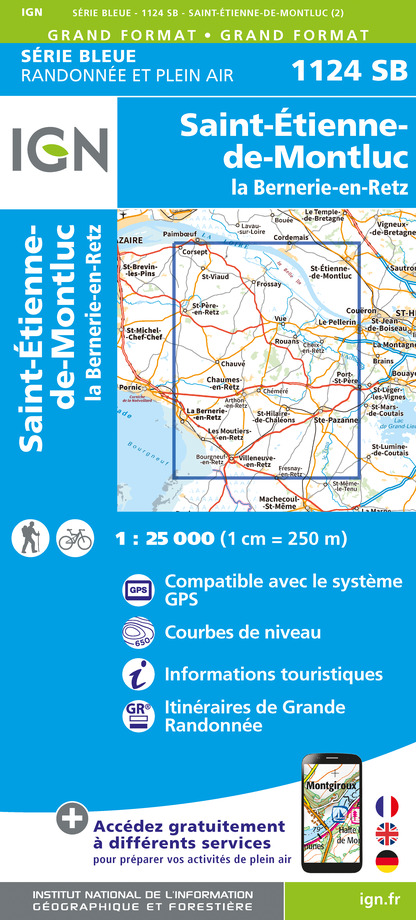
IGN cards






Data author
